Appendices
Appendix 1Important Patient-Physician Communication Skills
Part 1: Principles of Communication
Physicians effectively facilitate the doctor-patient relationship through the skillful application of communication skills1. Communication is a core skillset essential to the development of clinical competence. Communication involves both talking and actively listening in a careful and concerned way about the information the patient wants you to hear and understand. Practicing our professional communications skills and receiving standardized feedback from standardized patients, peers and preceptors is critical to learning how to communicate effectively2. Understanding communication and practicing it effectively is a skill that will assist you in your life-long practice of medicine.
Distinguishing a Conversation from a Medical Interview
In conversations, there is generally equal accountability between each party to discern, understand and ‘be present’. In a medical interview, the doctor has more responsibility to be present, active and directive in terms of information-gathering, attention to detail and active listening. The doctor is not present to discuss their own needs or problems with the patient. The doctor must be able to use their full set of verbal and non-verbal communication skills to understand the patient’s issues and must reflect in both non-verbal attending skills and verbal communication their understanding of the feeling and thinking messages of the patient.
Attributes of Effective Communicators
In clinical practice, challenging situations arise which may evoke strong feelings in the clinician – for example, feeling sad, afraid, or threatened, which can make it more difficult to communicate effectively. When we examine our own feelings during these difficult situations, we can call on these experiences to become more empathic to the suffering of patients and their loved ones. Through taping into our own feelings and acknowledging them, this also allows us to be ‘present’ in the moment, for example, when we communicate a serious illness diagnosis or take responsibility for an adverse medical event. Helpful characteristics include:
- Maturing – Always in a process of ‘becoming’ i.e. continuing to work on our own maturation issues and development.
- Cognitive Flexibility – Dynamic in thinking and actions and not rigid in their approaches to problems of others – (never only one ‘right’ way to address issues – always options)
- Self-Observant – Committed to continue to learn to observe themselves through emotional intelligence, (i.e., sensitive to internal thoughts, emotions, and limitations).3
- Platinum Rule – Remember to treat others as they would want to be treated when approaching patient-centred communication skills. For example, allow the patient to set the non-verbal agenda, where non-verbal communication norms may be culturally mediated (e.g. eye contact, facial expression, posture, gestures, physical distance).
Basic Tenets of Communication
- Three basic tenets of communication help clinicians to be centred on the task at hand, and using communication skills effectively:
- One cannot not communicate: We are sentient beings, capable of discerning nuance and imperceptible communications from one another. Even at birth and long before the acquisition of verbal skills, human beings begin to communicate. We are always communicating, measuring other people’s looks, body language and attitudes and looking for signs of communications. Often, we misinterpret communications from others and need to clarify – many times we do not do this. Whenever we are conscious, communication is occurring, and we need to be mindful of this, particularly in situations where we work with others on a regular basis.
- All communication implies a relationship: Think about your communication patterns. You probably act and speak and communicate differently in different situations. You may listen more attentively to a preceptor in an important active learning large group session versus when on public transit. Simply put, our communication patterns are affected by the audience and situation. Appropriateness of communication is just as important as appropriateness of dress or manner and all of these affect how we communicate with others.
- As human beings, we have the ability to meta-communicate: Meta- communication is the ability to ‘talk about communication’. Talking about communication helps us to understand the subtleties and nuances which naturally occur between and among human beings as they work to understand one another. This ability is a sophisticated skill and those who work with others must practice using their meta- communication skills, both in understanding others and in understanding their own reactions to events and incidents.4
Part 2: Advanced Communication & Medical Interview Skills
Advanced Directive & Goals of Care Discussions
Every admitted patient should have their goals of care clearly denoted in their chart. Suppose the patient had a cardiac arrest overnight on the ward – Do we know their goals of care? Will the on-call team be able to find this information easily in the chart? Unless alternative information is clearly documented (remember the chart is a medico-legal document), the assumption is the patient is full code i.e. that resuscitation be performed. This is unwanted trauma if it is against the patient’s wishes we either didn’t elicit or didn’t document.
Goals of care (GOC) discussions area values-based conversations about a patient grounded in current care at a specific moment in time, whereas Advanced Care Planning (ACP) is a future-oriented conversation about wishes and values for care. Goals of care should be revisited, particularly if the patient’s condition changes– for example, a patient admitted for CHF exacerbation and expected discharge to their retirement home clinically deteriorates.
- Learn from Modelling of Residents & Staff: Becoming comfortable and competent at Goals of Care discussions is a skill learned over time. There is no one prescriptive way to have a goals of care discussion; observe the helpful language that other practitioners use in goals of care discussions and find language that feels natural to you.
- This topic is explored further in Chapter 41 – Adult Palliative Care Assessment and associated Professional Competencies sessions as part of the Integration Foundation.
Medical Error3
Per CMPA Good Practices Guide, an error is an action (plan, decision, choice, and action or inaction) that, given the information available and the patient’s clinical condition at the time, was done wrongly or performed incorrectly in those circumstances, and therefore resulted in an adverse event (accident in Quebec) or a near miss. As a student, if you believe an adverse event has affected one of your patients, CMPA recommends you first ask yourself “Do I really have enough knowledge to say this is an adverse event?”
- Student’s Role if aware of an adverse event: Seek help as appropriate to manage the clinical situation; inform your supervising physician of the adverse event; provide emotional support to the patient; determine if you can attend the disclosure meeting to learn from the experience; apologize for your part in the adverse event if appropriate; document the adverse event and the discussion.
- Medical Error is not equivalent to negligence: Negligence, as per CMPA, is “a legal concept. In all provinces/territories of Canada except Quebec, to establish negligence by a physician, a plaintiff patient must prove to the satisfaction of a court that harm to the patient was caused by the failure to exercise a reasonable and acceptable standard of care by the physician. In the courts, the medical standard of care to determine negligence is not one of perfection but rather the standard of care that might reasonably have been applied by a colleague in similar circumstances.”
- Quality Improvement: It is important to be cognisant of fundamental attribution error – interpreting actions and behaviors of others based on the other’s person’s characteristics and personalities, but explaining their own actions based on situational factors. Quality Improvement (QI), a new addition to CanMEDS roles and increasingly an objective of residency training programs, encourages Systems Thinking – what upstream factors (including at an organizational level) led to the error? Quality Health Care is safe, effective, efficient, timely, equitable, and patient-centred. Hospitals now routinely have QI initiatives that are proactive. Become involved in these initiatives during Medical School if you can!
Communicating Risk5
As per CMPA recommendations, with any proposed investigation or treatment, it is important to:
- Discuss the common & serious risks in clear and understandable language. Discuss appropriate alternatives and the likely outcome of not doing anything.
- Provide the opportunity for the patient to voice concerns. Encourage questions.
- Even when patients waive aside all explanations or seem prepared to submit to the procedure or treatment without discussion, explain that the risks should still be discussed.
- Print material, videos, and other handouts all support the consent discussion, but do not replace it.
- Document the consent discussion in the medical record in a timely manner.
Respecting Physician-Patient Boundaries4
As per CMPA Good Practices Guide, a boundary is “an accepted social, physical or psychological space between people. Boundaries create an appropriate therapeutic distance between physician and patient and clarify their respective roles and expectations. In simplest terms, boundaries define limits of the therapeutic relationship.” Boundaries can be either benign (Boundary crossings), or harmful/exploitative to the patient (Boundary violations). It is important to be cognizant of the slippery slope that can occur when boundaries are progressively routinely crossed. In general, ask yourself what a neutral outside would say if observing your conduct. CMPA offers the following examples of common scenarios to watch out for to help prevent boundaries from not being respected:
- Examinations: Provide clear and timely explanations of reason for taking a history or doing an examination, and information about the nature of the examination.
- Sexual Histories: Ensure they are relevant to the clinical situation, and performed in a sensitive manner
- Intimate Exams: Use a chaperone
- Touching: Ensure touching will not be misinterpreted
- Respect Right to Privacy: Provide appropriate draping, and leave the room if the patient is changing their clothes
- Interactions with Patients: Look for early signs of emotional involvement (yours and your patient’s); see patients only in medically appropriate settings; be cautious of social contact outside the office or hospital; be knowledgeable about gender/cultural/ethnic sensitivities; be alert to possible misunderstandings
- Medical Students: Speak with a supervisor or mentor if involved in an actual or potential boundary issue
Cultural Safety6
As per CMPA Good Practices Guide, when physicians treat people equally, they ignore differences; when physicians treat equitably, they recognize and respect differences. It is important to achieve the ability to accept others’ points of view and to adapt your attitude without judgment, which requires continual conscious effort. Cultures incorporate a mix of beliefs and behaviors through which people define themselves and conform to societal values – including language, customs, rules, values, products, and institutions. In your role as a physician you cannot refuse to assess someone based on a conscientious objection; that said, physicians are not obliged to provide absolute accommodation in all situations, but rather to reasonable accommodate cultural diversity. The following are CMPA’s specific good practice points for Cultural Safety:
- Treat every patient encounter as potentially cross-cultural
- Ask patients to explain how their values, beliefs or religious or spiritual practices influence their preferences for the proposed medical treatment – a patient’s lack of adherence to treatment plans may have roots in cultural diversity
- Fully disclose information in a truthful manner, being diligent yet respectful of cultural diversity
- Do not select or exclude patients for reasons other than your clinical competence or expertise
- Do not avoid dealing with a healthcare issue because of your own cultural beliefs
Barriers to Understanding7
As per CMPA Good Practices Guide, doctor-patient communication is about fostering understanding, recognizing barriers, and finding ways to resolve them in a professional manner. Health literacy is defined as the degree to which individuals have the capacity to obtain, process, and understand basic health information and services needed to make appropriate health decisions. The following are CMPA’s specific good practice points for Patient-Centred Communication:
- Be polite
- Use language suited to the particular patient
- Be alert to non-verbal signs of uncertainty
- Confirm your patient’s comprehension
- Be prepared to get help with translation
- Be ready to adapt to cultural differences
- Consider alternative communication styles when necessary
Optimizing Use of Medical Interpretation Services8
When working with Medical Interpretation Services to facilitate patient-centred interviews, recommendations include:
Planning Interview
- Schedule enough time for the visit – everything has to be said twice, and sometimes what is said in a few words in one language may require many more in another language.
Beginning Interview
- When Working with Telephone Interpretation Services:
- Introduce yourself to the interpreter
- Introduce yourself and the interpreter to the patient, explain the purpose of the session
- Let the interpreter explain their role and the interpreting process
- Proceed with the interpretation, remembering to limit your communication to sections of manageable lengths and to pause often to allow the interpreter to speak
- Clearly indicate the end of the session
During Interview
- Avoid: Idioms, jargon, cultural references, humor, double negatives, rhetorical questions, compound questions or figures of speech
- Do: Speak to the patient, NOT the interpreter. Use simple straightforward sentences, proper nouns (not pronouns), examples, visual aids, and write out long numbers for the interpreter. Make one point at a time. Pause at the end of every 2-3 sentences (never mid-sentence); speak in your natural voice at your normal pace.
- Be Attentive if Interpreter Needs to Interrupt the Session: Interpreters may interrupt the session if they do not understand a word or concept used; if a cultural reference was used that could cause misunderstanding; if there is clear misunderstanding; if they need a phrase repeated; if they need to correct and interpretation mistake; if someone is failing to pause or speaking too quickly; or if the interpreter requires a break
Patient-Centred Electronic Medical Record Use – HUMAN LEVEL Mnemonic910
- Honour the “Golden Minute”: Make the start of the visit completely technology free. Greet the patient, start with their concerns and establish an agenda for the visit before engaging technology.
- Use the “Triangle of Trust”: Create a triangle configuration that puts you, the patient, and computer screen in each corner to facilitate eye contact between each without shifting your body position.
- Maximize patient interaction: Encourage patient interaction including in building their chart e.g. can share screen to ensure you’ve captured patient voice correctly.
- Acquaint yourself with chart: Review chart before you enter the room to prepare, inform and contextualize visit.
- Nix the screen: When discussing sensitive information, completely disengage from the EMR. Push monitor away, stop typing, take hands off the keyboard, and position yourself to face the patient.
- Let the patient look on: Share things on screen with the patient. Point to screen to engage. Be mindful of literacy, primary language, vision, etc.
- Eye contact: Maintain eye contact with patients as much as possible. Minimize screen gaze during the interview.
- Platinum Rule – Remember to treat others as they would want to be treated when approaching patient-centred communication skills. For example, allow the patient to set the non-verbal agenda, where non-verbal communication norms may be culturally mediated (e.g. eye contact, facial expression, posture, gestures, physical distance).
- Value the computer: Remember technology can be a helpful tool to engage patients (e.g. review lab results, decision aids)
- Explain what you’re doing: Signpost transitions to computer to tell them what you are doing, as you are doing it e.g. “Excuse me for a moment while I type this into the record.”
- Log-off: At end of visit, log off of chart while patient in room to reassure security of their personal health information
Trauma-Informed Care & ACE Questionnaires
Trauma-Informed Care (TIC)1112 is a framework for how providers and systems of care can work to reduce the likelihood of re-traumatization. Providing TIC does not require clinicians to ask for disclosures of trauma from patients, or to be experts in treating trauma symptoms. Trauma-informed principles can be applied to all clinical interactions to establish trust and to help patients to feel empowered. 5 principles of trauma informed care include121314:
- Safety: Includes physical, psychological, emotional, and interpersonal safety. Safety is defined by those we serve – “We must ask people what safety means to them. If we don’t challenge our own worldview, assumptions, and life experience regarding what safety means to us, we will not be able to ensure a sense of safety for ALL. We will simply be creating safety for people like us. We must ensure that we create safety for those who have different experiences from our own.”13
- Choice: Patients are supported in shared decision-making, choice and goal setting to determine the plan of action they need to heal and move forward. Many people with past trauma have experienced coercion. Therefore, choice is really important. A person must always have choice.
- Collaboration: Partnering and leveling power differentials in a spirit of mutuality and standing together. Healing happens in relationships and in meaningful sharing of power and decision-making.
- Trustworthiness: Decision-making processes are conducted with transparency with goal to build and maintain trust with patients, their loved ones, and organizational members.
- Empowerment: Empowerment comes from the person’s inner wisdom and strength, rather than power given to them from an outside “expert.” As clinicians, we shine a light on the strengths and abilities we see in someone, that they may not be able to see for themselves.
Universal Trauma Precautions Approach
Understanding that trauma and Adverse Childhood Experiences (ACEs) are common, universal trauma precautions help clinicians to provide safe care and support to reduce the risk of harm for all patients. Key principles include1112:
- Approach all patients as if they may have experienced trauma.
- Explain how stress and trauma can impact mental and physical health.
- Use open-ended questions and ensure patient-centred communication.
- Use collaborative care delivery, referring to trauma-informed providers when possible.
- Be diligent about professional self-care and watch for signs of vicarious trauma.
- Make small changes to language or behaviors to increase patient comfort, wellbeing, and control, and to reduce re-traumatization.
ACE Questionnaires
One screening intervention that may be incorporated into a medical assessment where appropriates is the ACE Questionnaire15 as a Screening maneuver. As introduced at Calgary’s Riley Park Maternity Clinic16, one method is as follows:
a. Say: Your emotional health is as important as your physical health. We are asking all our patients these questions as they can be important pieces of the overall puzzle that is your health. Would you be okay to complete a short questionnaire for this?
b. Do [If Agreement]: Give patient the ACE Questionnaire15 form.
c. Say [Once Completed]: I see that you have an ACE Score of [X]. You have been through some tough stuff, and I am very sorry that happened to you as a child. How has this impacted you?
d. Do: Listen empathically using a trauma-informed care perspective. The figure to the right17 illustrates how TIC can be integrated into Primary Care.
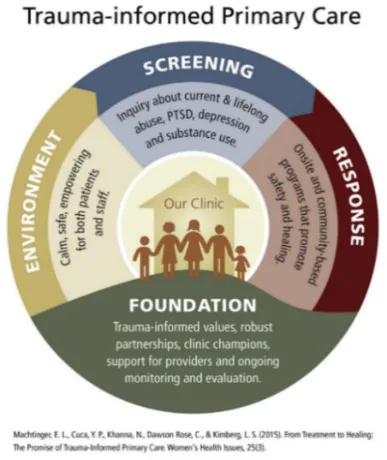
Trauma-informed Primary Care17
e. Say: Your brain and immune system were busy navigating a challenging environment when you were growing up so we know that you have a lot of resiliency; there may be some additional alternative strategies that might be helpful to learn now.
f. Do: Support and refer the patient; schedule appropriate follow-up as needed.
Key Principles for Clinical Skills Interviews for Persons with Disabilities and Suspected Cognitive Impairment18
The following are suggestions on modifications to medical interviews and clinical spaces to accommodate patients with disabilities. These are by no means comprehensive but should function as a good starting point for medical learners.
Caring for Non-Verbal or Anxious Patients
- Do as much as possible with patient dressed, sitting, standing, etc.
- Limit invasive exams. Do exams in order of patient preference.
- Does the patient need to be placed directly into an exam room?
- Does the patient use communication devices?
Caring for Mobility-Limited Patients
- Before the interview: Will patient need to be placed in particular room? Need assistance undressing/dressing? Need assistance using restroom? Need assistance transferring to the exam table?
- Ask the patient expert: How they prefer certain things done? If there are specific ways to help them move or transfer? If they need help undressing, dressing, cleaning up? What positions are most comfortable? If they brought someone to assist them?
Capacity Assessment
Capacity: The ability to use information to make choice congruent with own values and preferences. This includes understanding, expressing choice, appreciation, and reasoning through the options and one’s own preference. It is contextual to a specific choice and can vary and fluctuate over time and across different types of decisions. Assess the above 4 elements of capacity through patient interaction.
- Can you tell me in your own words what I just said about…?
- Based on our discussion, what would you choose?
- What do you see as your medical problem?
- a. Do you think it is possible that ___can benefit you? How could ___ harm you?
- How is x better than y? How could x affect your daily activities?
Even if the person has a POA for Personal Care, their capacity should be assessed every time, as they may be capable now or for a specific treatment
Approach for Difficult Conversations (Breaking Bad News) – SPIKEs (Last S is not part of acronym)
- S: Setting Up Interview: Physical environment (privacy, sitting down) and Planning (know your stuff for this role)
- P: Perception: FIFE - what is your understanding of the diagnosis? What do you think this might be? What is concerning you?
- I: Invitation from patient: How much would you like to know? Do you want me to explain the physiology of it? Prognosis?
- K: Knowledge: Tx options, what is likeliness of treatments being effective (share what you know re potential decisions)
- E: Emotions and Empathy: Assess the emotional state of the patient and give empathetic responses
Readiness Ruler: Assessing Readiness to Implement Behavioral Change
Assessing patients’ readiness to implement change can help the clinician determine how best to support the patient. To assess for patients’ Readiness to change, ask: On a scale of 1 to 10…
- Importance: How important is it to you to make this change?
- Readiness: How ready are you to make this change?
- Confidence: How confident are you that you can make this change?
- Confidence with supports: With additional support, how confident are you that you can make this change?
References
-
CanMEDS framework. Royal College of Physicians and Surgeons of Canada. Accessed March 16, 2019. http://www.royalcollege.ca/rcsite/canmeds/canmeds-framework-e ↩
-
Silverman JD, et al. The Calgary-Cambridge approach to communications skills teaching. Educ Gen Pract. 1996;7:288-99. ↩
-
CMPA. Section on Medical Error. CMPA Good Practices Guide. Accessed July 25, 2016. https://goo.gl/PCtD3u ↩ ↩2
-
CMPA. Section on Respecting Boundaries. CMPA Good Practices Guide. Accessed July 25, 2016. https://goo.gl/nxuiXd ↩ ↩2
-
CMPA. Disclosing harm from healthcare delivery: Open and honest communication with patients. Accessed May 22, 2019. http://bit.ly/2wb3NRI ↩
-
CMPA. Section on Cultural Safety. CMPA Good Practices Guide. Accessed July 25, 2016. https://goo.gl/Eoy0y0 ↩
-
CMPA. Section on Barriers to Understanding. CMPA Good Practices Guide. Accessed July 25, 2016. https://goo.gl/f4qzgw ↩
-
Guide to Working with Interpreters. Accessed March 11, 2019. http://www.cisoc.net/_files/Guide_to_Working_with_Interpreters.pdf ↩
-
Duke P, Frankel RM, Reis S. How to integrate the electronic health record and patient-centered communication into the medical visit: a skills-based approach. Teach Learn Med. 2013;25(4):358-365. ↩
-
Cristiano JA, et al. Integrating the electronic health record into patient encounters: an introductory standardized patient exercise for preclinical medical students. MedEdPORTAL. 2022;18:11209. ↩
-
Trauma-Informed Care Guide. National Coalition for Sexual Health. Accessed November 7, 2023. https://nationalcoalitionforsexualhealth.org/tools/for-healthcare-providers/trauma-informed-care-guide ↩ ↩2
-
What Is Trauma-Informed Care. University at Buffalo School of Social Work. Accessed November 7, 2023. https://socialwork.buffalo.edu/social-research/institutes-centers/institute-on-trauma-and-trauma-informed-care/what-is-trauma-informed-care.html ↩ ↩2 ↩3
-
SAMHSA’s Six Principles of Trauma-Informed Care. Accessed November 7, 2023. https://opentextbc.ca/peersupport/chapter/samhsas-six-principles-of-trauma-Informed-care/ ↩ ↩2
-
Substance Abuse and Mental Health Services Administration. SAMHSA’s Concept of Trauma and Guidance for a Trauma-Informed Approach. HHS Publication No. (SMA) 14-4884. Substance Abuse and Mental Health Services Administration; 2014. ↩
-
Finding Your ACE Score. National Council of Juvenile and Family Court Judges. Accessed March 8, 2019. https://www.ncjfcj.org/sites/default/files/Finding%20Your%20ACE%20Score.pdf ↩ ↩2
-
University of British Columbia. Accessed March 8, 2019. http://interprofessional.ubc.ca/files/2018/03/A1ii_Blemings.pdf ↩
-
Machtinger EL, Cuca YP, Khanna N, Dawson Rose C, Kimberg LS. From treatment to healing: the promise of trauma-informed primary care. Womens Health Issues. 2015;25(3):193-197. ↩ ↩2
-
Surrey Place. Accessed March 16, 2019. http://ddprimarycare.surreyplace.ca/ ↩