Medical Foundations 2
Chapter 11Lymph Node Examination
Part 1: Focused History – Based on Chief Complaint (Begin with Open-Ended Questions)
HPI, Associated Symptoms
Constitutional Symptoms
- Unexpected weight gain/loss, loss of appetite, fever, chills, night sweats, fatigue
- Concern for lymphoma, tuberculosis, or other malignancy
Enlarged Lymph Nodes
- Do you notice any abnormal lumps or bumps?
- Character: Onset, location, duration, number, tenderness
- Associated Symptoms: Pain, fever, redness, warmth, red streaks, itching
- Predisposing Factors: Infection (e.g. acute upper respiratory), surgery, trauma
Swelling of Extremity
- Character: Onset; Unilateral vs. Bilateral; Intermittent vs. Constant; Duration
- Associated Symptoms: Warmth, erythema, ulceration
- Predisposing Factors: Cardiac/renal disorder, surgery, infection, trauma, venous insufficiency, venous thromboembolism
Boney Pain
- Character: Onset, location, duration, quality, severity
- History of fractures, especially high-risk fractures (e.g. compression fractures)
Past Medical History (PMHx)
- Prior cancer, chemotherapy, or radiation – ↑ suspicion of new or recurrent cancer (including Non-Hodgkin’s Lymphoma)
- Which cancer? Staging? Metastasis?
- What treatment was used? What was intent of treatment – Neoadjuvant treatment (before primary treatment e.g. surgery) vs. Adjuvant treatment (after primary treatment e.g. surgery)? Palliative treatment (e.g. palliative chemotherapy for metastatic lung cancer – intent to control disease at good quality of life, rather than cure disease)
- Very important risk factor for recurrent breast cancer is previous contralateral breast cancer
- Previous mantle radiation (e.g. for classical Hodgkin’s Lymphoma) increases long-term risk of solid-tumor cancers including lung, breast, bone and soft tissue cancers
- Previous radiation treatment increases risk of future leukemia
- Cancer Screening: Is your age-related screening up to date per Cancer Care Ontario recommendations?
- Current Cancer Care Ontario Recommendations (for Cervical, Breast, Colon, Lung and Prostate Cancer)
- Pro Comp Connection: Cancer screening is an important opportunity for patient-centred shared decision making (e.g. using patient-centred decision aid tools)
- Recent infection (e.g. viral upper respiratory infection, streptococcal pharyngitis – can present with tender cervical LN)
- Epstein-Barr Virus (EBV – Infectious Mononucleosis) – presents with malaise, headache, low-grade fever and develop tonsilitis/pharyngitis, and tender cervical lymphadenopathy. A history of EBV also ↑ risk Non-Hodgkin’s Lymphoma
- History of Tuberculosis: Commonly presents with cervical lymphadenopathy, mediastinal lymphadenopathy (as complication of primary tuberculosis), peritoneal lymphadenopathy as well → was this treated?
- Recent Blood Transfusion: Risk of HIV (1 in 21.4 million), Hepatitis B Virus (1 in 12.6 million), Hepatitis C infection (1 in 7.5 million) – rare due to regular screening of blood bank. Also risk of Cytomegalovirus (rare). Acute HIV infection and CMV can present with nontender lymphadenopathy
- Autoimmune diseases (e.g. Systemic Lupus Erythematosus, Rheumatoid Arthritis, Sjogren’s Syndrome, Hashimoto’s Thyroiditis, Celiac Disease): ↑ risk of non-Hodgkin’s Lymphoma
- Paraneoplastic syndromes: common ones include excretion of PTHrP → HyperPTH, ACTH → Cushing, SIADH → HyperNa
- May be seen with lung cancers (especially small cell), renal cell carcinoma, hepatocellular carcinoma, leukemia, lymphoma, stomach cancers and pancreatic tumours
Past Surgical History (PS Hx)
- Previous definitive cancer surgery ± lymph node removal
- E.g. Mastectomy with lymph node dissection may cause lymphedema of affected side
- History of organ transplant (e.g. cardiac, lung, kidney, liver) re. immunosuppression ↑ risk Non-Hodgkin’s Lymphoma
- History of autologous hematopoietic cell transplant: May be indicated clinically in a number of hematologic malignancies depending on clinical course of treatment (e.g. previous disease relapses on chemotherapy) including:
- Acute myeloid leukemia (AML), Acute lymphoblastic leukemia (ALL), Chronic myeloid leukemia (CML), Chronic lymphocytic leukemia (CLL), Diffuse large B-cell lymphoma (DLBCL), Follicular lymphoma (FL) and Myelodysplastic Syndromes (MDS)
Family Medical History (FMHx)
- Family history of hematologic malignancy (e.g. lymphoma, leukemia)
- Family history of solid tumor cancers e.g. breast, colorectal, stomach, prostate, or ovarian cancer
- Age at diagnosis? Stage? Alive or dead? Age at death? Have you started screening?
- FMHx of early age cancer may affect age to start screening in colorectal cancer and breast cancer
- Genetic testing results, if available (e.g. BRCA in breast cancer)? May affect age to start screening
Social Hx
Pets at Home
Cats:
- Cat scratch disease: Presents with tender regional lymphadenopathy proximal to cat scratch, typically 2-weeks post-exposure (commonly axillary, epitrochlear, cervical, supraclavicular, or submandibular)
- Toxoplasmosis: Presents with bilateral symmetrical non-tender cervical lymphadenopathy
Travel Hx
- Any sick contacts? Any recent travel? Did patient attend a pre-departure travel medicine visit/clinic to ensure vaccinations up to date for travel to particular destination?
- Tick bites: Acute Lyme disease can present with regional lymphadenopathy, alongside classic erythema migrans rash (7-14 days after tick bite), and fatigue, anorexia, headache, neck stiffness, myalgias, arthralgias and fever.
Occupation
Excessive radiation exposure? - ↑ risk of malignancy
Smoking
- Pack years = packs/day x years smoking, important risk factor for lung cancer
- Have you thought about quitting in the next 6 months? Cigarettes? Marijuana? E-cigarettes/vapes?
- 5As approach taking a smoking Hx (Explored in Chapter 38 – Motivational Interviewing – IF)
- Pro-Comp Connection: Regarding patient’s position, do not jump to thinking in terms of “compliance” with recommendations for smoking cessation.
IV Drug Use
- Any other substance use? – IV Drug use ↑ infection risk (e.g. HIV, Hepatitis B Virus, Hepatitis C Virus, Infective Endocarditis); acute HIV can present with nontender lymphadenopathy
- HIV, Hepatitis B and Hepatitis C Viruses ↑ risk of Non-Hodgkin’s Lymphoma
Sexual History
(Explored further in Ch 18 – Detailed Sexual Histories – MF3)
Relevance - Select STBBIs Causing Lymphadenopathy:
- Syphilis: Can cause painless bilateral inguinal lymphadenopathy in primary syphilis, and generalized lymphadenopathy in secondary syphilis
- Herpes Simplex Virus (HSV): Can present with tender local inguinal lymphadenopathy
- Human Immunodeficiency Virus (HIV): Can present with nontender lymphadenopathy including inguinal, axillar, cervical and occipital nodes in acute HIV infection.
General Sexual History (seen in Chapter 1 – General Medical History – MF1)
- Normalizing Opening Statements2: Is it okay if I ask you a few questions about your sexual health? Some of questions are very personal. I ask everyone these questions, and I consider them to be very important. You do not have to answer any questions you don’t want to.
- Confidentiality Statement: Now and for the rest of our visits, this info will be kept confidential. I might take notes and put those in your chart here, but everything will be stored securely.
- General Sexual History34:
- Are you currently sexually active? (Are you having sex?)
- If not, have you ever been sexually active?
- How would your partners identify themselves in terms of gender?
- What kind of sex do you have (or have you had in the past): Vaginal sex (penetration of vagina)? Anal sex (penetration of anus)? Oral sex (mouth on penis/vagina/anus)? Manual stimulation of penis/vagina/anus?
- Are you the insertive or receptive partner or both? (Are you a top or a bottom?)
- How many different people have you had sex with in the past 2 months? In the past year?
- Note: Patients may interpret this question as irrelevant or invasive – inquire only when necessary, e.g. for STBBI testing or partner notification per public health reporting.
- Do you have any sexual concerns you would like to discuss?
- Note: A detailed sexual history may be added to a general sexual history, depending on patient care needs. To discuss sexual health in an effective and patient-centred way, it is important to ensure a safe, private and respectful environment. The 5P’s Model of Harm Reduction4 (Practices; Partners; Protection from Sexually Transmitted and Blood Borne Infections = STBBIs, Past History of STBBIs; and Pregnancy) is introduced in Ch 18 – Detailed Sexual Histories – MF3
Specific Questions to ask on Genitourinary History if concerns identified:
- Any abnormal discharge from the vagina/penis? Post-coital bleeding (after intercourse)?
- Any itchiness or pain in the genital area at rest? What about during urination?
- Any pain during/after intercourse (dyspareunia)? Pain while urinating (dysuria)?
- Do you notice any new lesions/spots/marks/moles/ulcers in the genital area?
- Have you ever had a Sexually Transmitted and Blood Borne Infections (STBBI)? – previous STBBI infections increase risk for future STBBI infections
Medications Hx, Allergies
Cancer Treatment
- Radiation treatment? Hormonal treatment (e.g. for hormone-responsive breast cancer)?
- Chemotherapy regimen? Immunotherapy regimen?
- Agents used? Side effects of agents? → look up drug monograph if uncertain
Medications that can cause lymphadenopathy
- Ask about recent new medications or changes to medications
- Common Examples: Sulfonamides (e.g. Trimethoprim-Sulfamethoxazole, Hydrochlorothiazide, Furosemide); Antiepileptic Drugs (e.g. Lamotrigine, Carbamazepine, Phenytoin); Antihypertensives (Atenolol, Captopril, Hydralazine); Allopurinol; Cephalosporins
Post-Organ Transplant Medications
(e.g. Cardiac, Lung, Kidney, Liver) – organ transplant recipients at ↑ risk of lymphoma
- Immunosuppressants:
- Calcineurin inhibitors (e.g. Tacrolimus, cyclosporine)
- Antimetabolic agents (e.g. Mycophenolate mofetil, azathioprine)
- Mechanistic Target of Rapamycin Kinase (mTOR) inhibitors (e.g. sirolimus, everolimus)
- Costimulatory Blockade agents (e.g. Belatacept)
- Glucocorticoids (e.g. Methylprednisolone, prednisone)
- Infection Prophylaxis: Trimethoprim-Sulfamethoxazole (prevent Pneumocystis Pneumonia); Valganciclovir or Ganciclovir (prevent Cytomegalovirus reactivation); other antivirals or antifungals targeted to individual patient.
Immunization History
- Particularly measles, mumps and rubella can cause lymphadenopathy
- Did patient receive Human Papillomavirus (HPV) vaccine? (2-dose primary series, covered for all children in school) – important to ↓ cervical cancer risk
- BCG (Bacillus Calmette-Guerin) Vaccination re. Tuberculosis – e.g. in immigrant and refugee populations (only on vaccination schedule in Nunavut at 1 month old in Canada)
- National Vaccination Schedule by Province/Territory
Part 2: Pertinent Notes about the Physical Exam
- Patient Draping: Start by exposing neck from chin down to manubrium and clavicles for neck lymph nodes; in stepwise fashion, then expose axilla, upper limbs, pelvis, and lower limbs, re-draping after each step completed.
Part 3: Specific Maneuvers in the Physical Exam – Say, Setup, Do, Report
Notes on Vitals
Vitals – Always do HR, BP, RR, Temp
In This Exam
AFMC level Pre-clerkship 4 · Clerkship 4
Looking for vitals characteristic of an acute infection (e.g. fever), disseminated infection (e.g. sepsis, fever, hypotension, tachycardia), or oncologic emergencies (e.g. arrhythmias, hypotension, tachypnea).
Inspection
General
AFMC level Pre-clerkship 3 · Clerkship 4
Say: I will begin with general inspection. As I assess for lymph nodes, I will also assess for masses, bruises, etc.
Do: Look at the patient and assess whether they are in acute distress or diaphoretic (heavy perspiration or sweating). With each area you examine, look for bruises, obvious masses, edema, asymmetry, color changes, obvious lymphadenopathy, surgical scars, erythema, rashes, etc.
Report: I note no signs of acute distress. There are no bruises, obvious masses or lymphadenopathy, surgical scars, erythema or rashes on inspection.
Why Check: General inspection routinely done; also, looking to get a clinical picture whether patient is currently well or unwell.
Tonsils
AFMC level Pre-clerkship 3 · Clerkship 4
– for complete Mouth inspection, please see Chapter 7 – Head & Neck Exam – MF1
Say: I will now inspect at the back of the throat for the tonsils. Can you say “Aaaah”?
Setup: Have both a light source and a tongue depressor available
Do: Look at hard palate for colour and form; soft palate and uvula for redness and swelling. When patient says “Aaaah”, the soft palate should rise symmetrically, and the uvula should remain in midline. You may need to use your tongue depressor to visualize the soft palate adequately. Assess tonsils for evidence of hyperplasia, inflammation, or exudates.
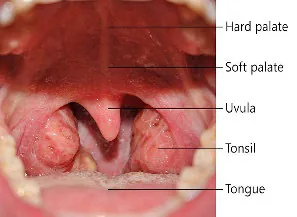
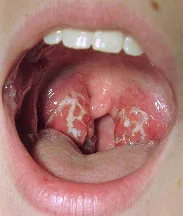
Normal Inspection5, Strep Pharyngitis6
Report: Uvula is midline on palate elevation. Tonsils are a Grade 0 with no focal inflammation or exudates.
- You can report your tonsil findings based on the Tonsillar Hypertrophy Grading Scale (Grade 0: Tonsils absent/atrophied; Grade 1: Tonsils 0-25% of oropharyngeal diameter; Grade 2: 25-50% of oropharyngeal diameter; Grade 3: 50-75% of oropharyngeal diameter; Grade 4: 75-100% of oropharyngeal diameter)
Why Check: Important in assessment of Acute Infectious Pharyngitis (e.g. Strep Pharyngitis vs. Viral Pharyngitis – in photo of Strep Pharyngitis above, note tonsillar exudate seen bilaterally – part of CENTOR score). With respect to tonsillar enlargement or snoring as chief complaint, this may require referral to ENT or Sleep Study for further study if clinically significant. Inspection for Acute Infectious Pharyngitis should also include a Head & Neck Examination – Chapter 7 (MF1). Oropharyngeal tumours and masses can cause deviations in the symmetry of the palate.
Modification for Patients with Obesity: Use a tongue depressor to visualize the posterior oropharynx. This may make it easier to see the oropharynx if the view is obstructed.
Percussion
Castell’s Sign-Spleen
AFMC level Pre-clerkship 3 · Clerkship 4
(Explored in Ch 13 - Abdo Exam - MF3)
Say: I will now be percussing the spleen in the left lower chest. Can you take a deep breath in? And now out?
Do: Percussion of point defined by last intercostal space along the anterior axillary line during full inspiration, looking for shift to dullness. Percuss throughout respiratory cycle. The area should remain tympanic throughout the breath. Any dullness throughout the breath cycle may indicate splenomegaly.
Report: Castell’s sign yields tympanic sounds throughout.
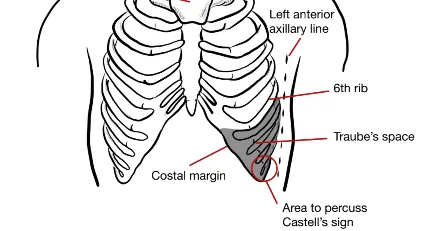
Why Check: A positive Castell’s sign mildly increases likelihood of splenomegaly, and a negative Castell’s sign mildly decreases likelihood of splenomegaly (LR+ 1.7, LR- 0.7)
Traube’s Space – Spleen
AFMC level Pre-clerkship 3 · Clerkship 4
(Explored in Ch 13 - Abdo Exam - MF3)
Say: I will now be percussing the spleen over a wider area in the left lower chest.
Do: Percussion of the area defined by the sixth rib superiorly, the anterior axillary line laterally, and the left costal margin inferiorly (see diagram above). You are looking for dullness – can be done along a straight line following the Left last intercostal space anteriorly until reaching anterior axillary line.
Report Traube’s space yields tympanic sounds throughout.
Why Check: Dullness on percussion of Traube’s space mildly increases likelihood of splenomegaly. Tympanic sounds on percussion of Traube’s space mildly decreases likelihood of splenomegaly (LR+ 2.1, LR- 0.8)
Palpation
Spleen
AFMC level Pre-clerkship 3 · Clerkship 4
(Explored in Ch 13 - Abdo Exam - MF3)
Say: I will palpate for an enlarged spleen in the abdomen. Please take a deep breath each time there is pressure on the abdomen.
Do: Use a deep palpation technique, where the spleen should not be palpable. The spleen moves down on inspiration due to the displacement of the diaphragm, so time your deep palpation during inspiration. Use your findings on percussion (Castell’s Sign, Traube’s Space) to guide the starting point of palpation:
- If Castell’s Sign/Traube’s Space yield tympanic sounds: Start palpation close to the left costal margin. You can pull the left side of the rib cage towards your right hand as you palpate for the spleen.
- If Castell’s Sign/Traube’s Space yield dull sounds (increasing likelihood of splenomegaly): Start palpation in RLQ along right MCL, moving slowly towards LUQ through umbilicus.
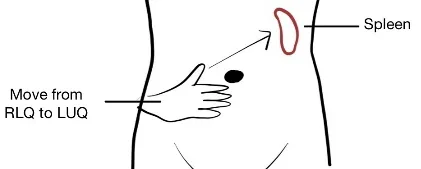
Report: The spleen is non-palpable, including on inspiration.
Why Check: Positive splenic palpation raises suspicion of splenomegaly. In cases of splenomegaly, the spleen will grow diagonally, so it is important to start at the RLQ and work towards the LUQ. A palpable spleen moderately increases the likelihood of splenomegaly (LR+ 8.5, LR- 0.5).
Lymph Nodes
AFMC level Pre-clerkship 3 · Clerkship 4
Say: I will palpate for lymph nodes. Please tell me if you are in discomfort.
Setup: Follow draping progression as suggested above.
Do: Follow the following chains USING PADS OF FINGERS (index & middle fingers, almost like a massage; move the skin in circular motion over underlying tissue in each area; compare bilaterally and move from light pressure to deep palpation). Feel the following lymph nodes in the head, neck and body. Look at the patient for signs of discomfort, and stop the exam if the patient is in distress.
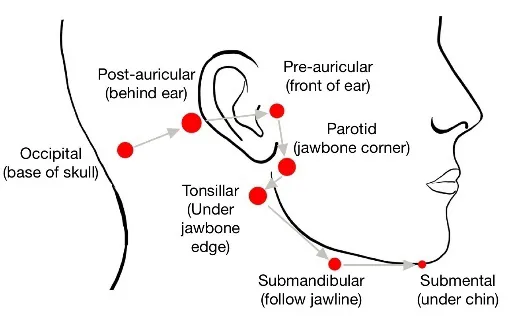
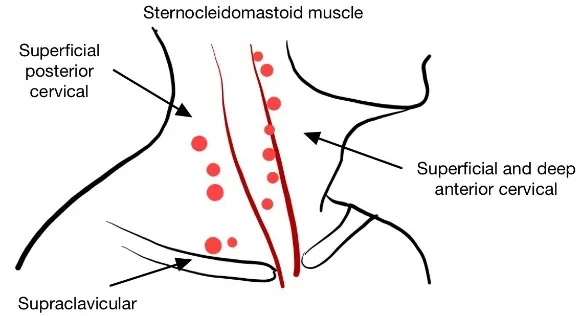
What is Normal?
- SIZE – < 1 cm
- SHAPE – Regular Borders
- TENDERNESS – Non-tender
- CONSISTENCY – Soft
- MOBILITY – Mobile
- Or may be non-palpable
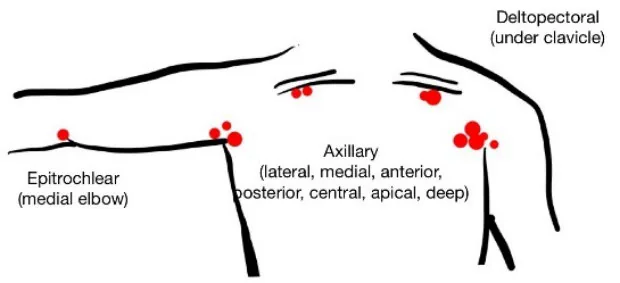
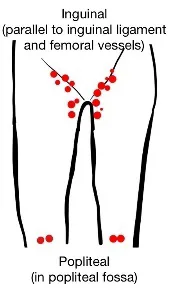
Report: Comment whether lymph nodes are palpable or not. If palpable, comment on location, number, size, shape, tenderness, consistency, and mobility.
Why Check: The lymphatic system works in a manner where lymph from different parts of the body is drained to particular nodes along the lymphatic vessels. This can allow you to localize or generalize an inflammatory or malignant process. As you examine lymph nodes, think about what regions they drain, and look for signs of infection or malignancy in these areas.
- Infection: Palpable, enlarged, tender lymph nodes, soft, mobile.
- Malignancy: Palpable, enlarged (>9cm² LR+ 8.4), hard (LR+ 3.2), non-tender (LR+ve 0.4 if tender, LR- 1.3 if non-tender), non-mobile (LR+ 10.9, LR- 0.7).
- Nodes may represent a metastatic solid tumor malignancy or a blood malignancy (e.g. lymphoma).
- Virchow’s Node (Left Supraclavicular Lymphadenopathy): Classically represents abdominal cancer metastasis, though may also be seen in non-GI malignancies (e.g. breast, pelvic, lymphoma)
- Note: Enlarged lymph nodes are usually, but not necessarily, indicative of current pathological process.
Part 4: Relevant Likelihood Ratios – from Rational Clinical Examination JAMA series
Clinical Question 1: Does this patient have Hepatomegaly or Splenomegaly?7
| Interpretation | Procedure | LR+ (95% CI) | LR- (95% CI) |
|---|---|---|---|
| Enlarged liver | Percussion Span >10cm in MCL | 1.2 (1.0-1.5) (no change: 95% CI includes 1) | 0.5 (0.2-1.7) (no change: 95% CI includes 1) |
| Actual liver edge | Palpable Liver | 233.7 (14.6-3737) (about +45%) | 0.5 (0.5-0.6) (about −15%) |
| Hepatomegaly | Palpable Liver | 1.8 (1.5-2.2) (about +15%) | 0.6 (0.5-0.8) (about −15%) |
| Splenomegaly | Palpable Spleen | 8.5 (6.2-11.8) (about +30%) | 0.5 (0.4-0.7) (about −15%) |
| Traube’s Space Dullness | 2.1 (1.7-2.6) (about +15%) | 0.8 (0.6-0.9) (about −15%) | |
| Nixon’s Sign | 2.0 (1.2-3.5) (about +15%) | 0.7 (0.6-0.9) (about −15%) | |
| Castell’s Sign | 1.7 (1.2-2.2) (about +15%) | 0.7 (0.5-0.9) (about −15%) |
Clinical Question 2: Does this patient have Lymphadenopathy from Malignancy or Granulomatous Diseases?8
| Procedure | LR+ (95% CI) | LR- (95% CI) |
|---|---|---|
| Fixed lymph nodes | 10.9 (2.0-59.2) (about +45%) | 0.7 (0.3-1.3) (no change: 95% CI includes 1) |
| Lymph node size >9 cm² | 8.4 (2.1-32.8) (about +30%) | N/A |
| Weight Loss | 3.4 (2.2-5.4) (about +15%) | 0.8 (0.8-0.9) (about −15%) |
| Hard texture | 3.2 (2.4-4.3) (about +15%) | 0.6 (0.4-0.7) (about −15%) |
| Supraclavicular nodes | 3.2 (2.3-4.3) (about +15%) | 0.8 (0.7-0.9) (about −15%) |
| Age 40+ years | 2.4 (1.7-3.5) (about +15%) | 0.4 (0.3-0.6) (about −30%) |
| Lymph node size 4 – 8.99cm² | 2.0 (0.4-9.2) (no change: 95% CI includes 1) | N/A |
| Male Sex | 1.3 (1.1-1.6) (about +15%) | 0.8 (0.7-0.9) (about −15%) |
| Generalized lymphadenopathy | 1.3 (0.6-2.9) (no change: 95% CI includes 1) | 1.0 (0.7-1.4) (no change: 95% CI includes 1) |
| Palpable Liver | 1.2 (0.7-1.9) (no change: 95% CI includes 1) | 1.0 (0.9-1.1) (no change: 95% CI includes 1) |
| Palpable Spleen | 1.2 (0.6-2.5) (no change: 95% CI includes 1) | 1.0 (0.9-1.0) (no change: 95% CI includes 1) |
| H&N Nodes (excluding supraclavicular) | 0.9 (0.8-1.1) (no change: 95% CI includes 1) | 1.1 (0.9-1.2) (no change: 95% CI includes 1) |
| Axillary nodes | 0.8 (0.6-0.9) (about −15%) | 1.1 (1.0-1.1) (no change: 95% CI includes 1) |
| Fever | 0.7 (0.5-1.0) (no change: 95% CI includes 1) | 1.1 (1.0-1.2) (no change: 95% CI includes 1) |
| Epitrochlear nodes | 0.7 (0.1-7.6) (no change: 95% CI includes 1) | 1.0 (1.0-1.1) (no change: 95% CI includes 1) |
| Inguinal nodes | 0.6 (0.4-0.7) (about −15%) | 1.1 (1.0-1.1) (no change: 95% CI includes 1) |
| Rash | 0.6 (0.3-1.4) (no change: 95% CI includes 1) | 1.0 (1.0-1.1) (no change: 95% CI includes 1) |
| Lymph node size <4cm² | 0.4 (0.3-0.7) (about −30%) | N/A |
| Lymph node tenderness | 0.4 (0.3-0.6) (about −30%) | 1.3 (1.1-1.5) (about +15%) |
| Lymph node score 7 or more | 21.9 (2.7-179.4) (about +45%) | N/A |
| Lymph node score 5 to 6 | 5.1 (2.9-8.8) (about +30%) | N/A |
| Lymph node score 0 to 4 | 1.1 (0.5-2.3) (no change: 95% CI includes 1) | N/A |
| Lymph node score -2 to -1 | 0.1 (0-0.3) (about −45%) | N/A |
| Lymph node score -3 or less | 0.04 (0-0.2) (about −45%) | N/A |
Lymph Node Score9 (Referred to Above)
*Max Score = 20 (i.e. a Non-Tender, Hard Lymph Node ≥9cm² in size, with Supraclavicular Lymphadenopathy and Generalized pruritus present in a patient >40 years old)
| Clinical Variable | Score |
|---|---|
| Age > 40 years | + 5 |
| Lymph Node Tenderness | - 5 |
| Lymph Node Size < 1cm² | 0 |
| Lymph Node Size 1-3.99 cm² | + 4 |
| Lymph Node Size 4-8.99 cm² | + 8 |
| Lymph Node Size ≥ 9 cm² | + 12 |
| Generalized Pruritus (itchiness) | + 4 |
| Supraclavicular Nodes present | + 3 |
| Lymph Node Hard | + 2 |
| Correction Factor (i.e. subtract 6 from every score) | - 6 |
Clinical Question 3: Does this patient have Infectious Mononucleosis?10
| Procedure | LR+ (95% CI) | LR- (95% CI) | |
|---|---|---|---|
| Physical | Posterior cervical adenopathy | 3.1 (1.6-5.9) (about +15%) | 0.69 (0.46-1.0) (no change: 95% CI includes 1) |
| Splenomegaly | 1.9-6.6 (about +15%) | 0.65-0.94 (about −15%) | |
| Any adenopathy | 1.2-2.1 (about +15%) | 0.23-0.44 (about −30%) | |
| Lab Tests | White blood cell count ≥ 50% lymphocytes and ≥ 10% atypical lymphocytes | 54 (8.4-189) (about +45%) | 0.58 (0.39-0.77) (about −15%) |
| Lymphocytosis (≥ 4 x 10⁹/L) in patients ≥ 18yo | 26 (17-42) (about +45%) | 0.04 (0.01-0.25) (about −45%) | |
| Atypical lymphocytes ≥ 10% | 11 (2.7-35) (about +45%) | 0.37 (0.26-0.51) (about −30%) | |
| Lymphocytosis (≥ 4 x 10⁹/L) in patients < 18yo | 5.6 (3.4-9.2) (about +30%) | 0.39 (0.22-0.69) (about −30%) |
References
-
Recommendations. Choosing Wisely Canada. Accessed August 1, 2022. https://choosingwiselycanada.org/recommendations/#list ↩
-
Centers for Disease Control and Prevention. Accessed March 11, 2019. https://www.cdc.gov/std/treatment/sexualhistory.pdf ↩
-
National LGBT Health Education Center. Taking Routine Histories of Sexual Health: A Systems Wide Approach for Health Centers. 2015. ↩
-
Canadian Public Health Association. Discussing Sexual Health, Substance Use and STBBIs. 2017. ↩ ↩2
-
File:Throat with Tonsils 0011J.jpeg. Wikimedia Commons. Accessed February 21, 2023. https://commons.wikimedia.org/wiki/File:Throat_with_Tonsils_0011J.jpeg ↩
-
File:Pos strep.JPG. Wikimedia Commons. Accessed February 21, 2023. https://commons.wikimedia.org/wiki/File:Pos_strep.JPG ↩
-
McGee S. Evidence Based Physical Diagnosis. Saunders; 2012:828-831. ↩
-
McGee S. Evidence Based Physical Diagnosis. Saunders; 2012:814-815. ↩
-
Vassilakopoulos TP, Pangalis GA. Application of a prediction rule to select which patients presenting with lymphadenopathy should undergo a lymph node biopsy. Medicine (Baltimore). 2000;79:338-347. ↩
-
Ebell MH, Call M, Shinholser J, et al. Does this patient have infectious mononucleosis? The rational clinical exam systematic review. JAMA. 2016;315(14):1502-1509. ↩

