Medical Foundations 4
Chapter 37Assessment of Substance Use Disorders
Resources for Learners
- MacHealth Opioids Clinical Primer online course: This program provides an overview of key concepts and skills for clinicians facing common challenges in the management of patients with chronic pain, including reducing the risks of opioids and addressing opioid use disorder. 3 courses focus on opioid use disorder, and3 courses focus on chronic pain, including safer opioid prescribing skills. You will encounter a subset of these courses longitudinally in the UGME curriculum.
- AFMC Opioids Foundational Curriculum: This comprehensive, foundational curriculum including an open-access course with 11 modules is tailored to undergraduate medical students. Each module takes 1-1.5 hours to complete. You will encounter a subset of these modules longitudinally in the UGME MD curriculum.
Part 1: Key Definitions in Substance Use Disorders
Addiction
A chronic relapsing disorder, state characterized by compulsive engagement in rewarding stimuli despite adverse consequences –4C’s of Addiction: Impaired Control over substance use; Compulsive use; Continued use despite Consequences; and Cravings.
Reinforcing Stimuli
Stimuli increasing probability of repeating behaviours paired with them.
Rewarding Stimuli
Stimuli brain interprets as intrinsically positive.
Addictive Drug
Drug that is both rewarding and reinforcing.
Addictive Behaviour
Behaviour that is both rewarding and reinforcing.
Dependence
Adaptations with prolonged use, including Physical Dependence (Adaptations to cells and tissues → persistent physical-somatic withdrawal symptoms when discontinuing intake) and Psychological Dependence (Emotional-motivational withdrawal symptoms when discontinuing intake).
Tolerance
Need to escalate dose to get same effect as obtained initially.
Sensitization
Gradually amplified response to drugs abused chronically (opposite to tolerance).
Harm Reduction
Policies, programs and practices that aim to minimize negative health, social and legal impacts associated with drug use, drug policies and drug use. Harm reduction is grounded in justice and human rights – it focuses on positive change and on working with people without judgment, coercion, discrimination, or requiring that they stop using drugs as a precondition of support. Principles of Harm Reduction include respecting the rights of people who use drugs; a commitment to evidence; a commitment to social justice and collaborating with networks of people who use drugs; and the avoidance of stigma. Goals of Harm Reduction include keeping people alive and encouraging positive change in their lives; reducing the harms of drug laws and policy; and offering alternatives to approaches that seek to prevent or end drug use.1 A recent paper describes 6 principles of Harm Reduction which can be generalized to working with other chronic conditions: Humanism; Pragmatism; Individualism; Autonomy; Incrementalism; and Accountability without termination.2
Part 2: Detailed Substance Use History
Chapter 1 introduced a basic substance use history to ask all patients in a medical interview, as follows:
Social Hx
These are questions we ask everyone, to get a more complete picture…
Substances
Smoking History: Pack years = packs/day x years…Have you thought about quitting in the next 6 months?
- 5As approach taking smoking Hx: Ask smoking status, Advise to quit in personalized way, Assess willingness to change, Assist with resources, & Arrange Follow-up (F/U)
Alcohol History: How Often Do You Drink (Drinks/Week)? What is the size of 1 drink? What kinds of drinks?
- Ask Permission: Would it be all right for us to talk about your relationship with alcohol?
- Single Alcohol Screen Question (SASQ, screen for unhealthy alcohol use): In the past year, how often have you had more than 4 drinks (females) or 5 drinks (males) on any 1 occasion? (+ve screen = 1+ occasions)
- AUDIT-C Questionnaire (screening for risk of alcohol use disorder; including binge-drinking for patients who may not be alcohol dependent) – each item rated from scale of 0 to 4:
- Q1: How often did you have a drink containing alcohol in the past year?
- Q2: How many drinks containing alcohol did you have on a typical day when you were drinking in the past year?
- Q3: How often did you have 6 or more drinks on one occasion in the past year?
- Scoring: Mild risk score 0-4; Moderate risk score 5-7; High risk score ≥ 8
- CAGE Questionnaire (screens for alcohol use disorder; may not capture binge drinking, not included in 2023 Canadian guideline for high risk drinking and alcohol use disorder3)
- Canada’s Guidance on Alcohol and Health focuses on a continuum of risk for weekly alcohol use4:
- Standard drink: 12oz of 5% alcohol (e.g. beer); 5oz of 12% (e.g. wine); 1.5oz of 40% (e.g. spirits)
- 0 Standard Drinks/Week: Not drinking has benefits such as better health, and better sleep
- ≤2 Standard Drinks/Week: Likely to avoid alcohol-related consequences for yourself or others
- 3-6 Standard Drinks/Week: ↑ Risk of developing several cancer types (e.g. breast, colon)
- ≥7 Standard Drinks/Week: ↑ Risk of heart disease or stroke
- Consuming >2 drinks per occasion: ↑ risk of harms to self and others (e.g. injuries and violence)
- When pregnant or trying to get pregnant: No known safe amount of alcohol use
- When breastfeeding: Not drinking alcohol is safest
Recreational Drug History5: Do you now use, or have you previously used any of the following substances:
- Marijuana (Clarify grams dried cannabis or # joints smoked per day or per week)
- What is the Red Flag Level for Marijuana? 3 joints per week
- Prescription drugs for non-medical purposes
- Street drugs (e.g. cocaine, ecstasy, heroin, MDMA, etc.)
- There are modified AUDIT questionnaires for various drugs (e.g. CUDIT for Cannabis)
Stages of Change (Motivational Interviewing, which has its roots in Addictions work): Pre-contemplation, Contemplation, Determination, Action, Maintenance
Why Ask: Screening for substance use helps identify important current and past patient risk factors. This can help inform a further exploration of Substance Use Disorders (See Chapter 37 – MF4), and opportunities to assess Stages of Change (See Chapter 38 – IF) and potentially connect the patient with supports. Key Idea: Social history includes, but is not limited to, sexual health and substance use history.
Part 3: Screening for Alcohol Use Disorder – Quick Screening Questions Review
Single Question Screen: How many times in the past year have you had X or more drinks in a day? (X = 4 for women, 5 for men)
Clinical Question 1: What is the potential clinical significance of a Single Question Alcohol Use Screen?6
| Condition | Sens. (95% CI) | Spec. (95% CI) | LR+ (95% CI) | LR – (95% CI) |
|---|---|---|---|---|
| Unhealthy Alcohol Use (Risky Amounts or Disorder) | 0.82 (0.73-0.89) | 0.79 (0.73-0.84) | 4.0 (3.0-5.3) (about +15%) | 0.2 (0.1-0.4) (about −30%) |
| Risky Consumption Amounts | 0.84 (0.75-0.91) | 0.78 (0.72-0.84) | 3.9 (3.0-5.2) (about +15%) | 0.2 (0.1-0.3) (about −30%) |
| Alcohol Related Problems or Disorder | 0.84 (0.74-0.91) | 0.75 (0.69-0.80) | 3.4 (2.6-4.3) (about +15%) | 0.2 (0.1-0.4) (about −30%) |
| Current Alcohol Use Disorder | 0.88 (0.73-0.95) | 0.67 (0.1-0.72) | 2.6 (2.1-3.3) (about +15%) | 0.2 (0.1-0.4) (about −30%) |
Part 4: What to do with a Positive Screen: Mnemonics and Screening Instruments
Substance Use Disorder (Any Substance of Abuse)
Mnemonic in Relationship to DSM-5: QUIT SPUD FTW
- Q – Quantity: Longer period/Larger amount than intended
- U – Unsuccessful: Efforts/desires to cut down
- I – Insight: Continued use despite knowledge of consequence
- T – Time: Significant time to obtain, use, recover from use
- S – Stop: Reduce important activities due to continued use
- P – Problems: Continue despite persistent problems
- U – Urge: Desire/craving to use
- D – Dangerous: Use in physically hazardous situations
- F – Fail: To meet obligations (work, school, home)
- T – Tolerance
- W – Withdrawal: Withdrawal, or substance taken to relieve
DSM-5 Correlation - Highlights:
- DSM Criteria: 2 of 11 listed in QUIT SPUD FTW required to make the diagnosis
- Key Ideas: Impaired control; social impairment; risky behaviour; and Pharmacological changes all a part of substance use disorders
- Specifiers: In early remission (no symptoms ± craving for 3-12 mo); In late remission (no symptoms ± craving for >12 mo); and in controlled environment (limited access)
- Severity: Mild (2-3 of 11 listed); Moderate (4-5 of 11); Severe (6+ of 11)
- Complication of Thiamine Deficiency (Alcohol): Wernicke’s Encephalopathy & Korsakoff’s Psychosis – 20% mortality; Thiamine used in alcohol metabolism, and ↓ absorption in presence of alcohol
Alcohol Intoxication
Mnemonic in Relationship to DSM-5: SINFUL:
- S – Slurred Speech
- I - Incoordination
- N - Nystagmus
- F – Focus: Impairment in attention or memory
- U – Unsteady Gait
- L – Loss of Consciousness: Stupor or Coma
DSM-5 Correlation - Highlights:
- DSM Criteria: 1 of 6 listed following a recent ingestion of alcohol, with clinically significant problematic behaviour or psychological changes during or shortly after alcohol use.
- Signs and symptoms not better explained by another medical condition or mental disorder (including other substance of abuse
Alcohol Withdrawal Syndrome (AWS)
Mnemonic in Relationship to DSM-5: HIP SATAN
- H – Hallucinations: Or illusions - transient visual/tactile/auditory
- I – Insomnia
- P – Psychomotor: Agitation
- S - Seizures: Generalized tonic-clonic
- A – Autonomic Hyperactivity: sweating, pulse rate > 100bpm
- T – Tremor: increased in hand
- A - Anxiety
- N – Nausea/ Vomiting
DSM-5 Correlation - Highlights:
- DSM Criteria: 2 of 8 listed in several hours - few days following cessation or ↓ alcohol use which has been heavy & prolonged
- Signs and symptoms cause clinically significant distress or impairment in important areas of functioning
- Specifier: With perceptual disturbance (rare)
- Management: Use the CIWA Protocol (Clinical Institute Withdrawal Assessment) to determine if patient needs Benzodiazepine sedatives in course of alcohol withdrawal syndrome. If patient had a seizure, can do prophylactic benzodiazepines.
Clinical Question 2: Does this patient have an Alcohol Problem? – Screening Instruments7
| Condition | Population | Test | Sensitivity (95% CI) | Specificity (95% CI) | LR+ (95% CI) | LR- (95% CI) |
|---|---|---|---|---|---|---|
| At Risk, Harmful or Hazardous Drinking | Adults | AUDIT-C ≥ 8 (n=1) | 0.40 | 0.97 | 12 (5.0-30) (about +45%) | 0.62 (0.52-0.74) (about −15%) |
| AUDIT ≥ 8 (n=2) | 0.57-0.59 | 0.91-0.96 | 6.8 (4.7-10) (about +30%) | 0.46 (0.38-0.55) (about −30%) | ||
| CAGE ≥ 2 (n=1; all pts > 60y) | 0.14 | 0.97 | 4.7 (3.7-6.0) (about +15%) | 0.89 (0.86-0.91) (about −15%) | ||
| CAGE ≥ 2 (n=2) | 0.49-0.69 | 0.75-0.95 | 3.4 (1.2-10) (about +15%) | 0.66 (0.54-0.81) (about −15%) | ||
| Pregnant Women | TWEAK ≥ 3 (n=3) | 0.67 (0.61-0.73) | 0.92 (0.91-0.93) | 8.4 (about +30%) | 0.36 (about −30%) | |
| TWEAK ≥ 2 (n=2) | 0.91 (0.87-0.94) | 0.77 (0.76-0.78) | 4.0 (about +15%) | 0.12 (about −30%) | ||
| T-ACE ≥ 1 (n=3) | 0.89 (0.81-0.94) | 0.75 (0.70-0.79) | 3.6 (about +15%) | 0.15 (about −30%) | ||
| CAGE ≥ 2 (n=3) | 0.48 (0.44-0.53) | 0.93 (0.92-0.93) | 6.9 (about +30%) | 0.56 (about −15%) | ||
| CAGE ≥ 1 (n=3) | 0.66 (0.62-0.70) | 0.81 (0.81-0.82) | 3.5 (about +15%) | 0.42 (about −30%) | ||
| Alcohol Abuse or Dependence | Adults | CAGE ≥ 2 (n=10) | N/A | N/A | 6.9 (4.2-11) (about +30%) | 0.33 (0.25-0.43) (about −30%) |
| CAGE ≥ 1 (n=10) | N/A | N/A | 3.4 (2.3-5.1) (about +15%) | 0.33 (0.25-0.43) (about −30%) | ||
| AUDIT ≥ 8 (n=2) | 0.66-0.71 | 0.85-0.86 | 4.6 (3.5-6.1) (about +15%) | 0.37 (0.28-0.49) (about −30%) | ||
| Women | CAGE ≥ 2 (n=2) | 0.58 (0.32-0.80) | 0.93 (0.90-0.95) | 8.3 (about +30%) | 0.45 (about −30%) | |
| CAGE ≥ 1 (n=1) | 0.89 (0.82-0.93) | 0.83 (0.79-0.86) | 5.2 (about +30%) | 0.13 (about −30%) | ||
| >60 y | CAGE ≥ 2 (n=3) | 0.13-0.82 | 0.82-0.99 | 5.2 (3.0-9.0) (about +30%) | 0.37 (0.29-0.47) (about −30%) | |
| CAGE ≥ 1 (n=2) | 0.79-0.98 | 0.56-0.88 | 2.6 (1.5-4.5) (about +15%) | 0.24 (0.15-0.40) (about −30%) | ||
| AUDIT ≥ 8 (n=1) | 0.33 | 0.91 | 3.6 (1.6-8.0) (about +15%) | 0.75 (0.58-0.90) (about −15%) |
Part 5: Toxidromes - Patient Comes in with an Overdose of Unknown Substance: What do you do?
- Step 1: ABCs – stabilize airway, breathing, circulation first
- Step 2: Hx – The problem is that it may be unreliable; OD may not be from a drug prescribed to that patient
- Step 3: Toxidromes – Methodology to narrow in on possible medications implicated in the OD based on focused physical examination looking at their pupils, vitals, and skin
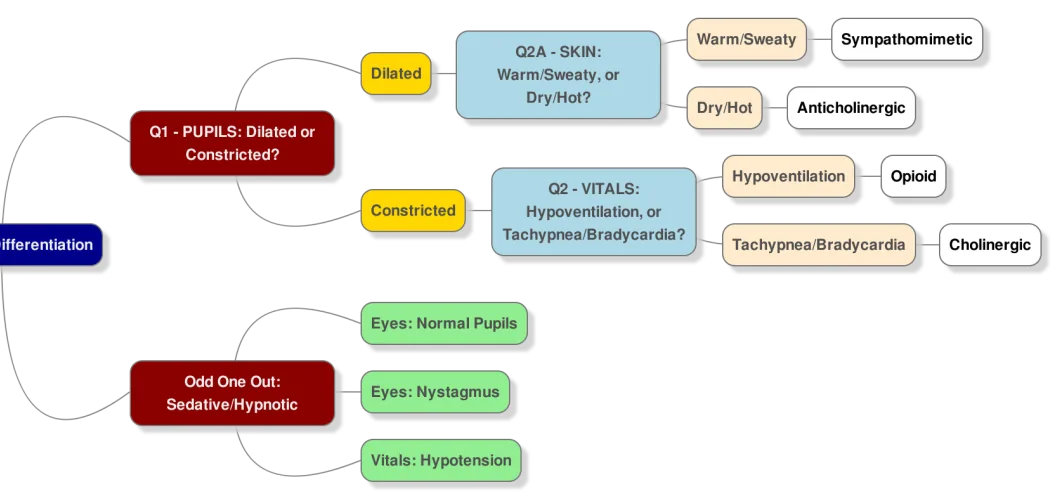
| Clinical Signs | Sympathomimetic | Sedative Hypnotic | Opiate | Anticholinergic | Cholinergic | Serotonin Syndrome |
|---|---|---|---|---|---|---|
| Toxin | Crack/Cocaine Amphetamines Serotonergics Methylphenidate NMDA | Benzodiazepines Barbiturates Ethanol | Morphine, Hydromorphone, Codeine, oxycodone, methadone, fentanyl | TCA Anti-psychotics Atropine, Benztropine Antihistamines | Organophosphates Muscarinics Mushrooms | SSRI, SNRIs, Clomipramine (TCA), St John’s Wart, Lithium, MAOIs, Triptans |
| Mental Status | Restless, paranoia, hallucinations, mania | Sedation, confusion, delirium, coma | Sedation, confusion, coma | Psychosis, Delirium, Seizures, Coma | Confusion, Drowsiness, Coma | Akathisia, Agitation, Delirium, Stupor, Coma |
| Pupils | Mydriasis | Normal | Miosis | Mydriasis | Miosis | Mydriasis |
| Vitals | Tachycardia, Hypertension, Hyperthermia | Bradycardia, Hypotension, Hypothermia | Hypoventilation | Tachycardia, Hypertension, Hyperthermia | Bradycardia, Tachypnea, Hypothermia | Tachycardia, BP Unstable (Severe =Hypotension), Hyperthermia |
| Other Px | Tremor, Warm Skin, Diaphoresis | Nystagmus, Hyporeflexia | Hyporeflexia | Urine Retention, Skin Dry & Red Hot | Salivation, Lacrimation, Urination, Defecation, Emesis | Shivering, Diaphoretic, Flushed, ++ Bowel sounds |
Part 6: Important Clinical Withdrawal Scales
- Clinical Opioid Withdrawal Scale (COWS Scale): For patients who are withdrawing from Opioids, the COWS Scale is the standard clinical tool in practice. It is useful to reproducibly rate common signs and symptoms of opioid withdrawal and to monitor over time and is validated both for the inpatient and outpatient setting. It is also used for induction with Buprenorphine/Naloxone (Suboxone) as part of Oral Opioid Agonist Therapy.
- Prediction of Alcohol Withdrawal Severity Scale (PAWSS): Stratifies risk of severe complications from alcohol withdrawal (e.g. seizures, delirium tremens) – Low risk if PAWSS score <4, high risk if PAWSS score ≥ 4 or if previous history of withdrawal seizure.
- Clinical Institute Withdrawal Assessment for Alcohol (CIWA Scale): For patients who are withdrawing from Alcohol, this presents significant risk of Withdrawal Seizures, Delirium Tremens, and others. The CIWA Protocol is the standard of care in managing Alcohol Withdrawal. It reproducibly rates common signs and symptoms of alcohol withdrawal and to monitor over time, with associated treatment recommendations based on scoring and a protocol for frequency of monitoring.
References
-
What is harm reduction. Accessed March 13, 2019. https://www.hri.global/what-is-harm-reduction ↩
-
Hawk M, et al. Harm reduction principles for healthcare settings. Harm Reduct J. 2017;14:70. ↩
-
Wood E, et al. Canadian guideline for the clinical management of high-risk drinking and alcohol use disorder. CMAJ. 2023;195(40):E1364-E1379. ↩
-
Canada’s guidance on alcohol and health. Accessed February 25, 2023. https://ccsa.ca/canadas-guidance-alcohol-and-health ↩
-
Canadian Public Health Association. Discussing Sexual Health, Substance Use and STBBIs. 2017. ↩ ↩2
-
Smith, et al. Primary care validation of a single-question alcohol screening test. J Gen Intern Med. 2009;24(7):783-788. ↩
-
Does this patient have an alcohol problem. In: Rational Clinical Examination Series. Chapter 4. 2009:49. ↩